
Building a house, a bridge, or even a small wall requires strong materials. One of the most important materials in construction is steel, specifically known as “rebar.” But how do you know how much steel you need? And more importantly, how much will it cost? This is where a Rebar Weight and Cost Calculator comes in handy.
In this guide, we will learn everything about calculating steel weight, understanding costs, and why using an online tool is the best choice for engineers, contractors, and home builders.
What is Rebar and Why is it Important?
Rebar stands for “Reinforcing Bar.” It is a steel bar or mesh of steel wires used in reinforced concrete and masonry structures. Concrete is very strong when you squeeze it (compression), but it is weak when you pull it (tension). Rebar provides that missing strength.
Because steel is sold by weight, knowing the exact weight of the rebar you need is critical. If you buy too little, your work stops. If you buy too much, you waste money. This is why accurate calculation using a Rebar Weight and Cost Calculator is essential for every project budget.
The Problem with Manual Calculation
In the old days, engineers used pen and paper to calculate the weight of steel. They had to remember complex formulas and do long multiplication sums.
For example, to find the weight, they had to know the density of steel, the diameter of the bar, and the length. Then they had to multiply it by the total number of bars.
This method has problems:
It is slow: It takes hours to calculate steel for a whole building.
It creates mistakes: One wrong number can mess up the whole budget.
It is confusing: converting from feet to meters or tons to kilograms can get tricky.
Today, you don’t need to do this manually. You can simply Calculate rebar weight and cost online to save time and ensure safety.
How Does a Rebar Weight and Cost Calculator Work?
A Rebar Weight and Cost Calculator is a digital tool designed to make your life easier. It uses standard engineering formulas to give you an instant answer.
Here is how it typically works:
Select the Diameter: You choose the size of the bar (like 8mm, 10mm, 12mm, etc.).
Enter the Length: You type in how long the bar is or the total length required.
Enter Quantity: How many pieces of that bar do you need?
Get Results: The calculator instantly shows you the total weight and the estimated cost.
This tool works as a Rebar weight by diameter calculator, meaning it adjusts the math based on how thick the steel bar is.
The Science Behind the Calculation
Even though the Rebar Weight and Cost Calculator does the work for you, it is good to know the math behind it. The standard Rebar weight calculation formula used worldwide is:
W = Weight of the rebar in Kilograms.
D = Diameter of the bar in millimeters (mm).
L = Length of the bar in meters.
162 = This is a derived constant based on the density of steel (7850 kg/m³).
So, if you are wondering How to calculate rebar weight manually, you calculate the square of the diameter, divide it by 162, and multiply by the length. But why do the math yourself when a tool can do it instantly?
Key Features of a Good Calculator
When you are looking for a Rebar weight and cost calculator tool, you should look for specific features that cover all your needs.
1. Weight Calculation
The primary job is to find the weight. Whether you need the Rebar weight per meter or the Rebar weight per foot, the tool should be able to switch between units. In many countries, steel is sold by the meter, but construction plans might be in feet. A good calculator handles both.
2. Cost Estimation
Knowing the weight is only half the battle. You also need to pay for it. A Rebar cost calculator feature allows you to input the current market price of steel.
If you are buying in bulk, you might need to know the Rebar cost per ton.
For smaller jobs, you might calculate the Rebar cost per kg.
Sometimes, contractors charge based on length, so knowing the Rebar cost calculation per meter is helpful.
3. Total Project Estimation
A simple Rebar weight calculator might just do one bar. But a comprehensive Rebar Weight and Cost Calculator will let you add different lists. You can calculate 50 bars of 10mm and 20 bars of 16mm, and the tool will add them all up to give you a final “Bill of Quantities” (BOQ).
Understanding Rebar Sizes and Weights
To use a Steel rebar weight calculator effectively, you should be familiar with standard sizes. Here is a simple breakdown of common rebar sizes used in residential and commercial construction.
6mm Bar: Very thin, used for stirrups (rings) that hold thicker bars together.
8mm & 10mm Bars: Commonly used in floor slabs and small home foundations.
12mm & 16mm Bars: Used in columns and beams for heavy load support.
20mm, 25mm, & 32mm Bars: Used in heavy construction like bridges, dams, or high-rise buildings.
The weight increases significantly as the diameter goes up. For example, a 12mm bar is much heavier than a 10mm bar, even if the length is the same. The Rebar Weight and Cost Calculator automatically accounts for this difference in density and volume.
Why Accuracy Saves You Money
Imagine you are building a house. Your engineer tells you that you need 2000 meters of 12mm steel.
If you don’t calculate correctly, two things can happen:
Overbuying: You estimate you need 2500 kg of steel. You buy it. But actually, you only needed 2000 kg. You have just wasted money on 500 kg of steel that will sit and rust.
Underbuying: You estimate 1500 kg. Halfway through pouring concrete, you run out of steel. The work stops. You have to pay for emergency transport to bring more steel. This delays the project and increases labor costs.
Using a precise Rebar price calculator helps you create an exact budget. You can check the daily market rates and plug them into the calculator to see if the supplier is giving you a fair deal.
How to Use This Tool: A Step-by-Step Guide
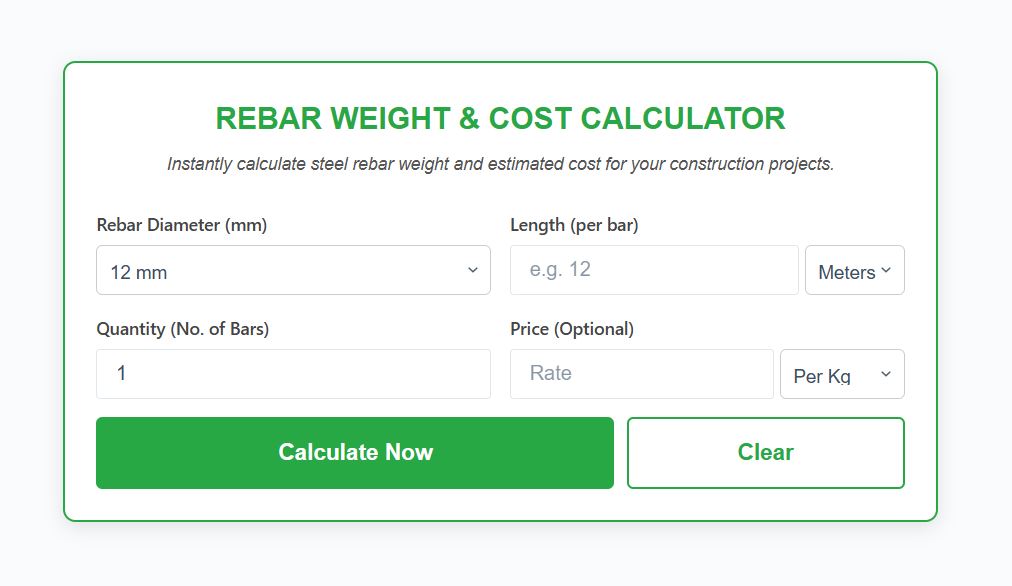
Using our Rebar Weight and Cost Calculator is as easy as using a regular calculator on your phone. Follow these simple steps:
Step 1: Gather Your Data
Look at your construction blueprints or ask your contractor. You need to know the diameter of the bars (in mm) and the total length required.
Step 2: Input the Diameter
Select the size of the rod. For example, choose “12mm”.
Step 3: Input the Length
Enter the length. You can usually choose between meters or feet. The tool will calculate the Rebar weight per meter internally.
Step 4: Enter the Price (Optional)
If you want to know the cost, enter the current price of steel in your area (e.g., $700 per ton or $0.70 per kg).
Step 5: Click Calculate
Hit the button! The Rebar Weight and Cost Calculator will instantly show you the total weight in tons or kilograms and the total price.
Benefits of Online Calculation vs. Excel Sheets
Many engineers use Excel sheets. While Excel is good, it is not always accessible on a construction site. An online Rebar weight and cost calculator tool works on your mobile phone.
Mobile Friendly: You can check estimates while standing on the construction site.
Up-to-date: You don’t need to write formulas; the tool is always ready.
Unit Conversion: It easily converts standard metric units to imperial units (like Rebar weight per foot), which is very hard to do quickly in your head.
Avoiding Common Mistakes
Even with a Rebar Weight and Cost Calculator, you must be careful. Here are common mistakes people make:
Mixing Units: Ensure you are not multiplying meters by price per foot. Always match your units.
Ignoring Waste: In construction, you always cut bars, and small pieces are wasted. Always add about 3% to 5% extra to your final calculation from the Rebar weight calculator to account for wastage and cutting.
Confusing Diameter: A 12mm bar and a 10mm bar look similar but have very different weights. Always double-check the size tags on the steel bundles.
Summary of Rebar Unit Weights
To give you a quick idea before you use the calculator, here are standard weights for 1 meter of steel:
8mm: ~0.395 kg
10mm: ~0.617 kg
12mm: ~0.888 kg
16mm: ~1.580 kg
20mm: ~2.470 kg
You can see that a 20mm bar is almost four times heavier than an 8mm bar! This is why guessing is dangerous and why a Rebar Weight and Cost Calculator is your best friend in construction estimation.
Frequently Asked Questions (FAQs)
Here are the most common questions people ask about calculating steel.
1. How accurate is the Rebar Weight and Cost Calculator?
The calculator is extremely accurate because it uses the standard theoretical density of steel ($7850 kg/m^3$). However, actual manufacturing variations in steel bars can cause a tiny difference of +/- 2%.
2. Can I use this as a Rebar price calculator for different currencies?
Yes! The math for cost is simple multiplication. Whether you put the price in Dollars, Rupees, Euros, or Pounds, the calculator will multiply the weight by your input price to give the correct total.
3. What is the difference between Rebar weight per meter and per foot?
This refers to the unit of measurement. “Per meter” is the metric system used in most of the world. “Per foot” is the imperial system. Our tool allows you to check Rebar weight per foot if your drawings are in feet.
4. How do I calculate the cost if I only know the price per ton?
First, use the tool to find the total weight in kilograms. Divide that by 1000 to get the weight in tons. Then, multiply that number by the Rebar cost per ton market rate.
5. Does the Rebar weight calculation formula change for different grades of steel?
No. Whether it is Grade 40, Grade 60, or TMT bars, the density of steel remains roughly the same. You can use the same calculator for all standard construction steel.
6. Can this tool help me with Rebar cost calculation per meter?
Absolutely. If you enter a length of 1 meter and the price per meter, it will show you the cost. This is useful when buying small quantities from a hardware store.
7. Why do I need to know the Rebar cost per kg?
Retailers often sell small amounts of steel by weight (kg) rather than by the ton. Knowing the Rebar cost per kg helps you verify the bill when buying loose bars for small repairs.
Related Posts
Top 5 Construction Cost Estimation Tools for 2025
Free Concrete Bag Calculator | How Many 60lb or 80lb Bags Needed?
How to Read Construction Blueprints for Beginners
Final Thoughts
Construction math does not have to be scary or difficult. By using technology, we can save time, reduce waste, and keep our budgets on track. A Rebar Weight and Cost Calculator is an essential tool for anyone involved in building.
Whether you are a student learning about civil engineering, a contractor managing a site, or a homeowner trying to check material costs, this tool simplifies the process. Instead of worrying about the complex math of Rebar weight by diameter calculator formulas, you can focus on the quality of your construction.
Always remember to double-check your inputs, account for a little bit of wastage, and check current market rates for the Rebar cost per ton. With these steps, your project estimation will be professional and accurate.
Start using the Rebar Weight and Cost Calculator today and build with confidence!