
Most Common 4 Digit PINs to Avoid in 2026 (Full List of Unsafe PIN Codes)
Imagine you have a strong metal safe, but you leave the key right on top of it. That is exactly what happens when you use a weak password for your phone or bank card. In the digital world, your 4-digit PIN is that key. Today, we are going to talk about the most common 4 digit PINs that you must avoid if you want to stay safe.
Many people think that because there are 10,000 possible combinations for a 4-digit code, their number is safe. But sadly, that is not true. Human beings are predictable. We like patterns, easy numbers, and dates that we can remember. Hackers know this, and they use the most common 4 digit PINs to break into phones and accounts in seconds.
In this guide, we will look at the weak 4 digit PIN list, understand why they are dangerous, and show you how to protect yourself.
Why Common 4 Digit PINs Are Dangerous
Security experts have analyzed millions of leaked passwords and PIN codes. The results are shocking. A huge percentage of people use the exact same numbers. If you are using one of the most common 4 digit PINs, you are making it very easy for thieves.
When a thief steals a phone or tries to access an ATM, they do not just guess random numbers. They start with the popular PINs hackers guess. They know that people are lazy when it comes to security. If your PIN is easy to type or easy to remember, it is likely on the list of unsafe 4 digit PIN codes.
Using a secure 4 digit PIN is the first line of defense. If you use a weak one, it does not matter how expensive your phone is or how secure your bank is; the thief can walk right through the front door.
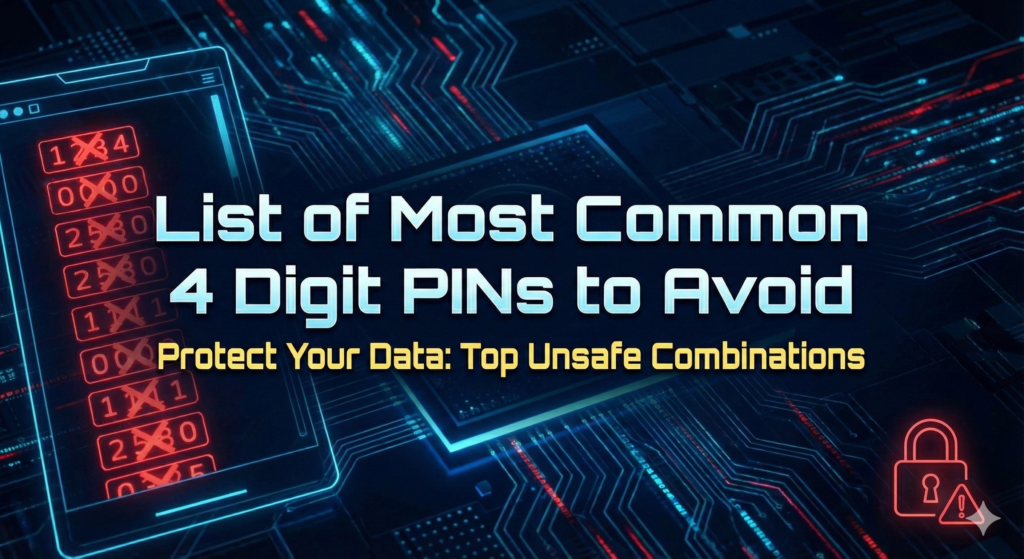
List of Most Common 4 Digit PINs to Avoid
Here is the moment of truth. Below is a breakdown of the numbers you should never use. These are the most common 4 digit PINs found in data breaches all over the world.
1. The “1234” Problem
Believe it or not, “1234” is still the king of bad passwords. It is the first number a thief will try. It is estimated that nearly 11% of all PINs are “1234”. If this is your code, change it immediately. It is definitely one of the most common 4 digit PINs in history.
2. Repetitive Numbers
People love repetition because it is fast to type. However, these are easy to guess PIN numbers.
- 1111
- 0000
- 2222
- 5555
- 9999 These numbers are terrible for security. They offer zero protection against a brute force attack (where a hacker tries many numbers quickly).
3. Keypad Patterns
Some people look at the shape of the keypad and make a pattern. For example:
- 2580 (This is a straight line down the middle of the keypad).
- 0852 (The line going up). These are frequently used PIN codes because our brains like visual shapes. But remember, hackers know what a keypad looks like too.
4. Years and Dates
This is a very common mistake. People use their birth year or a famous year.
- 1990 through 2005 (Common birth years).
- 2020, 2025, or 2026 (Current years). Using a year makes your code one of the most common 4 digit PINs because if a thief knows your birthday (which is easy to find on social media), they can guess your PIN instantly.
Why Hackers Guess These PINs First
You might wonder, “How do they know?” It comes down to psychology. Hackers know that you want to unlock your phone quickly. They know you don’t want to forget your number. Therefore, they rely on common 4 digit PIN numbers that are convenient for you.
When a hacker gets a list of credit card details or phone data, they run software that tries the most used 4 digit PINs first. They don’t start with “8301” or “0629”. They start with “1234”, “0000”, and “1111”. By avoiding these bad PIN choices, you instantly make yourself safer than 20% of the population.
This is why PIN security mistakes can cost you money. It is not about bad luck; it is about bad choices.
Real-World Examples of Weak PINs
Let’s look at where we use these codes. You use them for ATM PIN safety tips, mobile lock PIN risks, and even smart door locks.
Imagine you lose your wallet. It has your ID card (with your birth date) and your debit card. If your ATM PIN is your birth year (e.g., 1995), the thief has everything they need. This is why birth years are considered unsafe 4 digit PIN codes.
Another example is mobile phones. If you leave your phone at a coffee shop and your PIN is “2580” (the straight line), a casual observer might have seen you type it in earlier because it is such a distinct hand movement. Predictable PIN numbers are hard to hide from prying eyes.
How to Create a Secure 4 Digit PIN
Now that we know what not to do, how do we make a good one? A good PIN should look random to everyone else but have a special meaning to you. It should not be on the list of most common 4 digit PINs.
Use the “Word” Method
Think of a 4-letter word that is not your name. For example, “JUMP”. Look at the keypad on your phone.
- J = 5
- U = 8
- M = 6
- P = 7 So, your PIN becomes 5867. This is much harder to guess than “1234” and is not one of the worst 4 digit PINs.
Use Two Numbers Meaningful Only to You
Combine two separate numbers that are not dates. For example, the number of your first house (e.g., 42) and the age of your first pet (e.g., 09). The PIN becomes 4209. This is random enough to avoid being one of the hacked PIN combinations.
The Best Method: Use a Tool
The absolute best way to ensure your PIN is not one of the most common 4 digit PINs is to let a computer choose it for you. Humans are bad at being random; computers are excellent at it.
You should use a trusted tool to create a code that has no pattern.
👉 Generate a secure 4 digit PIN using our free tool. This tool ensures that you get a truly random number that isn’t tied to your birthday or a keypad pattern.
Using a random 4 digit PIN generator removes the “human element” that hackers rely on. When you create a safe PIN instantly with a tool, you are stepping out of the danger zone.
Secure PIN Alternatives
If you are worried that even a strong 4-digit PIN isn’t enough, there are other secure PIN alternatives.
- 6-Digit PINs: Many devices now allow you to use 6 digits. This increases the possible combinations from 10,000 to 1,000,000. It is much harder to guess a 6-digit code than one of the most common 4 digit PINs.
- Biometrics: Using your fingerprint or Face ID is generally safer than a simple number, provided you have a strong backup PIN.
- Alphanumeric Passwords: If your device allows it, use a password with letters and numbers. This is the gold standard for security.
However, for most ATMs and quick access, the 4-digit code is still standard. So, making sure you aren’t using weak 4 digit PIN list numbers is your priority.
Analyzing the “Top 10” Worst List
Let’s look at the data again. Here are the top 10 most common 4 digit PINs revealed in major studies. If your PIN is here, change it now.
- 1234
- 1111
- 0000
- 1212
- 7777
- 1004
- 2000
- 4444
- 2222
- 6969
Seeing a pattern? They are all easy to guess PIN numbers. Hackers try these 10 numbers and successfully unlock a surprising number of phones. By simply picking a random number like “8492”, you are safer than millions of people who use unsafe 4 digit PIN codes.

The Role of Location in PIN Security
While math is the same everywhere, location-based keywords and habits can sometimes influence PINs. For example, in some cultures, certain numbers are lucky, so people use them more often. However, the rule of “1234” being dangerous is universal. Whether you are in New York, London, or Mumbai, avoiding the most common 4 digit PINs is a global security rule.
Always remember that mobile lock PIN risks happen everywhere. Do not assume you are safe just because you don’t live in a big city.
Final Tips for PIN Safety
- Don’t write it down: Never write your PIN on a piece of paper in your wallet.
- Shield your hand: When typing your code at an ATM or store, cover your hand. Even if you don’t use one of the most common 4 digit PINs, a camera or a person behind you might see it.
- Change it regularly: If you have had the same PIN for 5 years, it might be time for a change.
- Check for cleanliness: On touchscreens, sometimes grease spots show which numbers you press. Wipe your screen often!
Frequently Asked Questions (FAQs)
1. What is the number 1 most common 4 digit PIN?
The single most common PIN is “1234”. Research shows that more than 10% of people use this combination. It is the first number hackers try.
2. Is “0000” a safe PIN code?
No, “0000” is extremely unsafe. It is usually the second or third most popular PIN. It is very easy to guess and offers no security for your device or card.
3. Why are birth years bad for PINs?
Birth years (like 1990 or 2005) are bad because your birth date is public information. A thief can find it on your ID or social media and guess your PIN immediately.
4. How can I make my PIN harder to guess?
To make a PIN hard to guess, avoid patterns, repetitive numbers, and dates. The best method is to use a random number generator to pick a code that has no connection to your personal life.
5. Are 6-digit PINs safer than 4-digit PINs?
Yes, 6-digit PINs are safer because they have 1 million possible combinations, whereas 4-digit PINs only have 10,000. However, a random 4-digit PIN is still better than a weak 6-digit PIN (like 123456).
6. Can hackers guess my PIN if it is not on the common list?
It is much harder for them. If your PIN is truly random, a hacker would have to try thousands of combinations, which most phones and ATMs do not allow (they lock up after 3 or 5 tries).
7. Where can I generate a secure PIN?
You can use a trusted online tool. We recommend you free 4 digit PIN generator to get a strong, random code instantly.
Generate a Secure 4 Digit PIN
Instead of using common or predictable PINs, generate a random and secure 4 digit PIN using our free online PIN generator.
Generate Secure 4 Digit PINRelated Post
- Is a 4 Digit PIN Secure? Pros, Cons & Safer Alternatives
- Common 4 Digit PIN Mistakes You Should Never Make: Secure Your Data
- How to Generate a Random 4 Digit PIN (Free & Secure Methods)
- What Is a 4 Digit PIN & How Does It Work?
- Common & Best Uses of 4 Digit PIN Codes in Daily Life
- 4 Digit PIN vs 6 Digit PIN: Which Code Length is Safer for You?
Final Thought
Your digital security is in your hands. Using one of the most common 4 digit PINs is like leaving your front door unlocked. It is a small mistake that can lead to big problems.
Take a moment today to check your codes. If you are using “1234”, “1111”, or your birth year, change it right now. Do not rely on luck. Instead, rely on randomness. Use our random 4 digit PIN generator to ensure that your private data stays private. Stay safe and keep your numbers hard to guess!