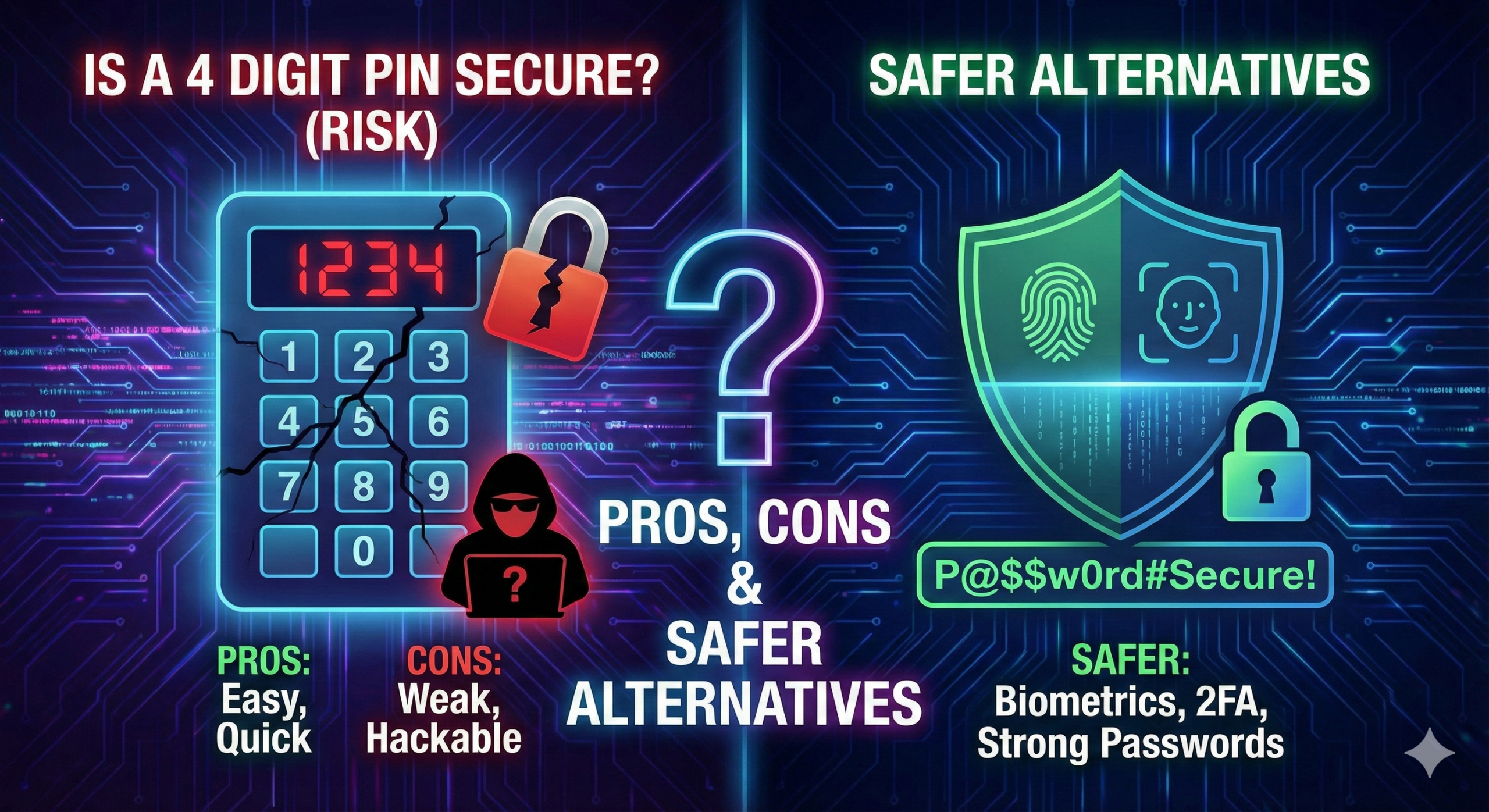

Is a 4 Digit PIN Secure? Pros, Cons & Safer Alternatives
In today’s world, we use passwords and PINs for everything. From unlocking our phones to getting cash from the ATM, that little number code is the key to our private life. But have you ever stopped to ask yourself: is a 4 digit pin secure enough to protect my data?
Most people choose a PIN because it is fast and easy to remember. However, hackers and thieves are getting smarter every day. They use special tools and tricks to guess your code. In this guide, we will explore 4 digit pin security, why some codes are dangerous, and how you can keep your information safe.
If you are worried that your current code is too simple, you don’t have to guess. You can use a random 4 digit pin generator to create a unique code instantly.
The Basics: How Secure Is a 4 Digit PIN?
To understand if your code is safe, we first need to look at the math. A 4-digit PIN is made up of numbers from 0 to 9. When you have four spaces and ten options for each space, there are exactly 10,000 possible combinations (from 0000 to 9999).
So, when we ask, is a 4 digit pin secure, we are really asking how hard it is for someone to guess one of those 10,000 combinations.
The Problem with Predictability
If you pick a number randomly, you have a 1 in 10,000 chance of someone guessing it on the first try. That sounds pretty safe, right? The problem is that humans are not random. We like patterns. This affects 4 digit pin strength significantly.
Many people choose codes that are easy to type or easy to remember. This creates weak pin codes that thieves try first. If you use a year like “1990” or a pattern like “2580” (which is a straight line down the keypad), your security is much lower.
In reality, is a 4 digit pin secure if you use a pattern? The answer is no. A thief can guess these common patterns in just a few seconds.
Common 4 Digit PINs to Avoid
There was a study done on millions of leaked passwords and PINs. The results showed that people are very predictable. If you want pin code safety, you must avoid the most common numbers.
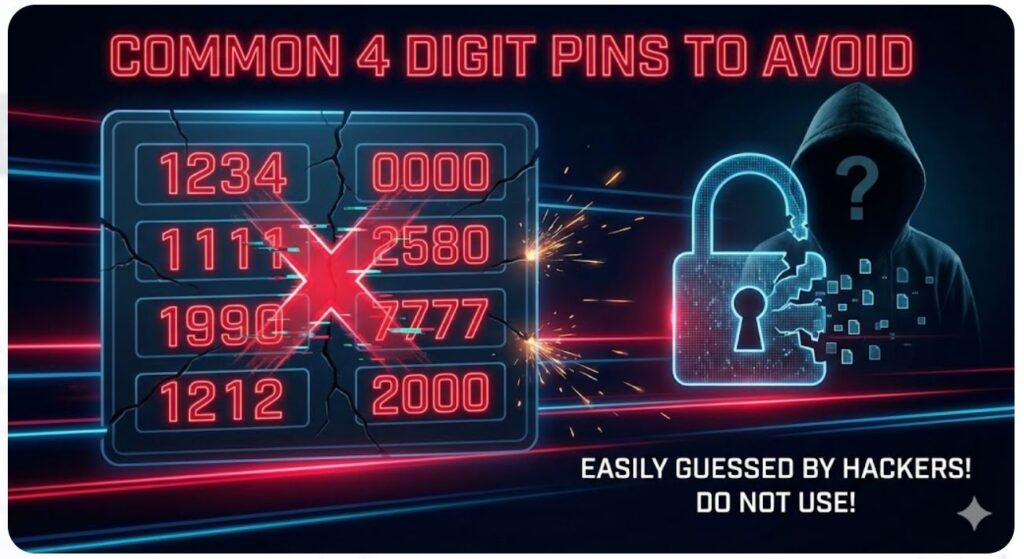
Here is a list of common 4 digit pins to avoid:
- 1234: This is the most common PIN in the world.
- 1111: Repeated numbers are very easy to guess.
- 0000: Often the default setting for devices.
- 1212: Simple repetition.
- 7777: People consider this a “lucky” number.
- Birth years: Like 1995, 2000, or 2005.
If your PIN is on this list, you are at high risk. You need to change it immediately to a secure pin code. Using a predictable number increases the pin guessing risk massively.
Brute Force Attacks: Can Hackers Crack It?
A brute force pin attack is when a computer program tries every single combination from 0000 to 9999 until it finds the right one.
Because there are only 10,000 combinations, a computer can try all of them in a fraction of a second. So, technically, if a hacker has unlimited tries, the answer to “is a 4 digit pin secure?” is “not at all.”
Why Your Phone Does Not Unlock Instantly
Luckily, most devices have built-in protection. They limit how many times you can try.
- Limited Attempts: After 3 or 5 wrong tries, the phone locks up.
- Time Delays: You have to wait 1 minute, then 5 minutes, then 1 hour before trying again.
- Data Wipe: Some phones will delete all data after 10 wrong attempts.
These features improve mobile pin security because they stop the brute force attack from working quickly.
ATM PIN Security: Is Your Money Safe?
We use 4 digits for our bank cards almost every day. ATM pin security works a bit differently than your phone.
When you are at an ATM, no one is using a computer to hack your code. Instead, criminals use physical tricks:
- Shoulder Surfing: Someone watches you type your code.
- Skimmers: A fake keypad placed over the real one to record your presses.
- Thermal Cameras: Believe it or not, thermal cameras can see the heat from your fingers on the buttons to know which numbers you pressed.
In this context, is a 4 digit pin secure against physical theft? Only if you hide your hand while typing. Always cover the keypad with your other hand to ensure pin code safety.
Random PIN vs Predictable PIN
The biggest factor in safety is randomness. We need to compare a random pin vs predictable pin.
- Predictable PIN: Based on your birthday, anniversary, or a keypad pattern. A close friend or a thief who stole your wallet (and sees your ID) can guess this easily.
- Random PIN: A set of numbers with no connection to your life, like “8305” or “1749”.
A random number is much harder to guess. It forces the attacker to rely on luck. To get the best protection, you should always generate a strong 4 digit PIN that has no link to your personal information.
4 Digit PIN vs Password Security
Many people wonder about pin vs password security. Which one is better?
A password usually has letters, numbers, and symbols. It is much longer than 4 characters. Mathematically, a password is billions of times stronger than a PIN. However, typing a long password every time you unlock your phone is annoying.
Numeric pin security is a compromise. It is less secure than a complex password but much faster to use. For high-security accounts (like email or crypto wallets), use a password. For quick access (like unlocking a screen), a PIN is usually acceptable if you use secure authentication methods like fingerprint or Face ID along with it.
So, is a 4 digit pin secure compared to a password? No, but it is convenient.
How to Create a Secure PIN Code (Best Practices)
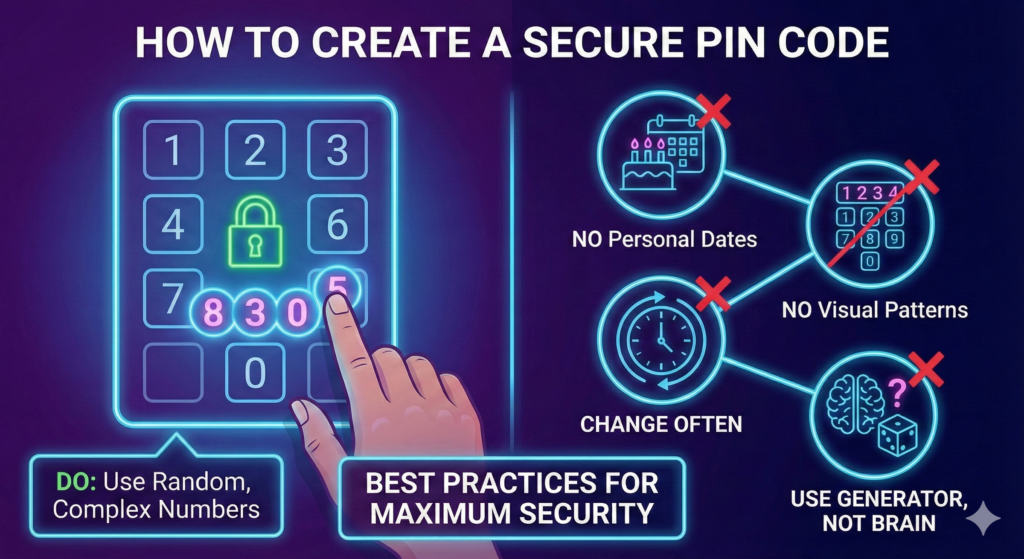
If you must use a 4-digit code, you need to follow pin security best practices to stay safe. Here are some tips to boost your security:
1. Don’t Use Personal Dates
Never use your birthday, your child’s birthday, or your wedding anniversary. These are the first things a thief will try if they have your wallet.
2. Avoid Visual Patterns
Do not spell out words on the keypad or make shapes (like a square or an ‘L’ shape).
3. Change It Often
Do not keep the same PIN for years. Changing it every few months reduces the risk if someone has seen you type it in the past.
4. Use a Generator
The human brain is bad at being random. The best way to get a truly secure pin code is to use a tool.
Pro Tip: Instead of using predictable PINs like 1234 or 0000, you can secure 4 digit PIN using our free online tool. This ensures the number is mathematically random.
Is a 6-Digit PIN Better?
Many devices, especially iPhones, now ask for a 6-digit PIN. Is this really better?
- 4-Digit Combinations: 10,000
- 6-Digit Combinations: 1,000,000
Yes, a 6-digit PIN is 100 times stronger than a 4-digit PIN. If you have the option, always switch to 6 digits. However, if you are stuck with 4 digits, you must ensure you are not using weak pin codes.
The Role of Location-Based Security
Did you know your location matters? Location-Based Keywords often relate to banking rules. In some countries, 4 digits are standard. In others, 6 digits are required.
If you travel, be aware of ATM pin security in different regions. Sometimes, if you have a 4-digit PIN and the ATM asks for 6, you simply type your 4 numbers and press enter. Never add zeros to the end unless your bank tells you to.
Strong PIN Examples
What does a good PIN look like? It should look like nonsense. Here are some strong pin examples (do not use these, generate your own!):
- 8492
- 3057
- 6183
- 9204
These numbers have no pattern, no repetition, and are not dates. They maximize 4 digit pin strength.
When you look at these numbers, you might think, “I will never remember that!” But that is the point. If it is hard for you to remember, it is hard for a thief to guess. You can memorize it with practice.
Is a 4 Digit Pin Secure FAQs
Here are some common questions people ask about PIN safety.
1. How secure is a 4 digit pin compared to Face ID?
Face ID and fingerprint scanners are much more secure than a PIN. They are part of secure authentication methods. However, your phone still needs a PIN as a backup. If your PIN is “1234”, your Face ID doesn’t matter because a thief can just bypass it with the code.
2. Can hackers guess my PIN if I use a 4 digit pin generator online?
If you use a trusted tool to 4 digit PIN generator online, the number is generated locally or securely. Hackers cannot guess it because it follows no pattern. It is much safer than picking a date.
3. Is a 4 digit pin secure for my Smart Door Lock?
For smart homes, 4 digits are okay, but 6 is better. The biggest risk with door locks is worn-out buttons. If you press the same 4 buttons every day, they get dirty or worn. Thieves can look at the keypad and see which numbers are used. Change your code often to avoid this.
4. What should I do if I forget my secure PIN?
If you choose a random code, you might forget it. Write it down on a piece of paper and hide it in a safe place at home (never in your wallet). Do not save it in your phone notes labeled “PIN”.
5. How does mobile pin security protect against theft?
Modern phones encrypt your data using your PIN. If you restart your phone, you must enter the PIN to decrypt the storage. This means even if a thief plugs your phone into a computer, they cannot see your photos or messages without the PIN.
6. Is “2580” a safe PIN?
No. “2580” is a straight line down the middle of the keypad. It is one of the most common 4 digit pins to avoid. It is very low in 4 digit pin strength.
7. How often should I change my ATM PIN?
To maintain high ATM pin security, you should change your PIN every 3 to 6 months. Also, change it immediately if you suspect someone saw you type it.
Generate a Secure 4 Digit PIN Instantly
Instead of using predictable PINs like 1234 or 0000, generate a random and secure 4 digit PIN using our free online tool.
Generate Secure PIN →Related Posts
If you enjoyed this guide on pin code safety, you might like these other tools and articles:
- Strong Password Generator
- How to Create a Memorable but Safe Password
- What Is a 4 Digit PIN & How Does It Work?
- Fire Text for Gaming Names
Final Thoughts
So, is a 4 digit pin secure? The honest answer is: it depends on you.
If you use “1234” or your birth year, it is not secure at all. It is like leaving your front door unlocked. However, if you use a truly random number and keep it secret, a 4-digit PIN is secure enough for most daily tasks like unlocking a phone or using an ATM.
The key is to avoid being lazy with your security. Do not pick the easy option. Take a moment to think about pin security best practices.
To ensure you have the best protection, don’t rely on your own brain to pick a number. It is always smarter to generate a strong 4 digit PIN using a random tool.
Stay safe, protect your data, and update that “1234” code today!